
F-ZERO
エフセロ
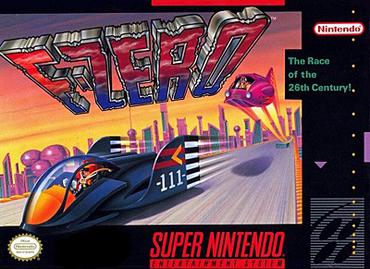

Released November 21, 1990
Published by Nintendo
Developed by Nintendo EAD
Introduction:
F-Zero and Super Mario World made the perfect duo launch titles for the Super Famicom. One was a sequel to a much beloved Nintendo platformer, and the other was a fast-paced futuristic racer, a new standard for futuristic racing games disguised as a Mode 7 tech demo. Mode 7 allowed for raster graphic plane scaling, which provides the illusion of the 3D racing track in F-Zero. The "Pseudo 3D" holds up really well, never once did I feel like I wasn't in a 3D racing game. Although Captain Falcon was better introduced in Super Smash Bros and F-Zero X on the N64, he does actually get an introduction, not in the game but in the manual. Overall, F-Zero is a fast-paced adventure in frustration, euphoria, and bad memories about being stuck in the middle of a bunch of bumper cars operated by 8-year olds (who probably kicked dirt in your face on several occassions).
Origin and Development:
 F-Zero is named after Formula One Racing because in the future there is no need to go forward, only backwards on numerical scales. Shigeru Miyamoto as producer and Takaya Imamura as Character and Graphic Designer. Imamura is best known for his work on Star Fox, the F-Zero series, and, most recently, Steel Diver. He was also a supervisor on the subsequent F-Zero anime. Many ties to Star Fox can be found throughout the F-Zero series, most notably James McCloud in F-Zero X (basically Fox McCloud out of his furry costume). I guess Imamura's love for recycling has leaked into his professional life, though I really love the idea of multiverses. The composers of the soundtrack, Yumiko Kanki and Naoto Ishida, created an amazing, atmospheric soundtrack yet only composed for a handful of other SNES soundtracks, Star Fox 2 and Super Scope 6, respectively.
Story:
It takes place in the future, there's hovercars and stuff, rich people pay to see hover car races blah blah blah. Here's the comic that was in the back of the manual, it'll clear things up.


Gameplay:
F-Zero is a short, but brutal racing game. You get to choose between three leagues in grand prix mode: Knight, Queen, and King, ranging in difficulty respectively. Before you enter the race, your choice of vehicle determines your destiny for the league. Do you want to go really fast but then explode right before you finish in first? Pick the Golden Fox! Withstand heavy damage but finish in 4th every lap? Pick the Pico! The Fire Stingray (Pink) is the best vehicle by far, able to withstand plenty of damage, maintain consistent speed, and navigate through tricky corners. The Blue Falcon is said to be for beginners, but I found it to be a good vehicle throughout most of the King League.
The goal of each stage is to finish in 3rd place or higher on the final lap. The first three have qualifications too (15th, 7th, 5th). If you place below the threshold, its game over man. Once you finish a league, you go to a records board. There really isn't a credits screen, unless you beat a league on Master level, which you unlock by beating a league in Expert level. I finished each league on beginner and even that took me several hours. Sorry, but I don't have a credit screen for you.
Controls are very fine tuned, but difficult to master. Using the L and R buttons, you can make sharp turns easier. It's not just the shoulder buttons, you must find the right time to accelerate so you don't skid out of control. After each completed lap, a turbo boost is given allowing you to maximize speed for a brief time. Using this at the wrong time can cause you to crash, or, even worse, turn the whole game into a round of bumper cars. The most frustrating levels have magnets which will pull your vehicle towards the bumpers if you do not steer away. The very last stage of King League, Fire Field, is very brutal, mostly because of its ridiculous turns.
Overall, I enjoyed every bit of F-Zero. Even when I continued to crash on a hard level, I didn't mind going back to the beginning of the league and starting over. In a way, repeating the stages is the best practice for harder stages. The Mode 7 never seems gimmicky or overbearing, it still lures you into the illusion that this is a 3D racing game. I was a bit disappointed that after finishing King League, there was no credit screen, no real payoff for that torture.


